Showing posts with label Process. Show all posts

Friday, June 17, 2011

Bodiverse is Back!

My Neuro Detour hasn't found its highway yet, and it's more likely I've become a POW of my own body, mind, and society's ignorance and bigotry... but that's for another time.

Along the Detour, I immediately lost my body and mind - my dance and my poetry - my entire universe, my bodiverse. They're still doing their own thing, but I've come to terms with the moment.

After a year without any creative outlet, I moved on from my project doodles and sketches to painting and collage and cane designing - when I could. And eventually, I accepted the encephalytic, TM, MS, RSD brain of mine as it was and allowed it to find its own creative voice. It was absolutely pointless to try to write and read and speak like I did pre-Neuro.

Every day, or minute, or let's stick with the concpt of moments , my body speaks a new language, moves (stumbles, falls, or lays bed-ridden) with such improvisation, I don't recognize myself most of the time. The closest I come to dancing is cane dancing, vertigo, and my falls - no longer choreographed. Even my bones speak a new language - aged and brittle with Osteoperosis and Osteopenia from repetitive treatments like IV steroids, meds, and the disease processes - don't ask me how.

There's a lot of verse left in this body - broken and fragmented as it is.

And, until recently all of that verse has been exposed on paper as experiential imagery or writings of all sorts and styles.

Surprisingly, people liked my art, and even bought it, and that's how we come full circle here. And I hope to stay, and come back - as frequently as my body and mind allow.

But for now....

BODIVERSE IS REVIVED!

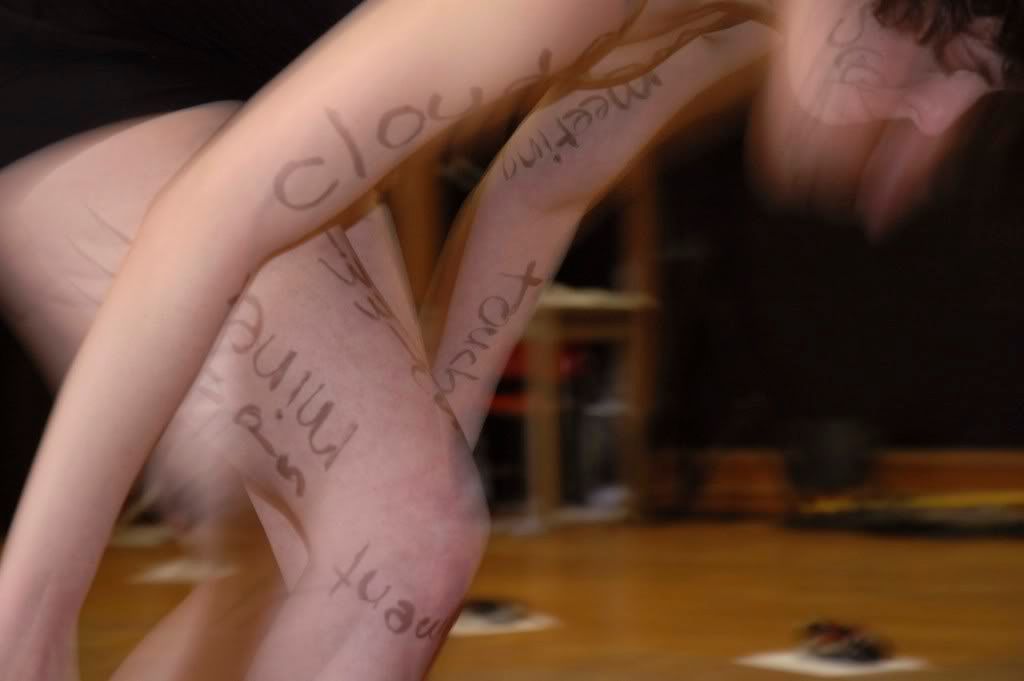
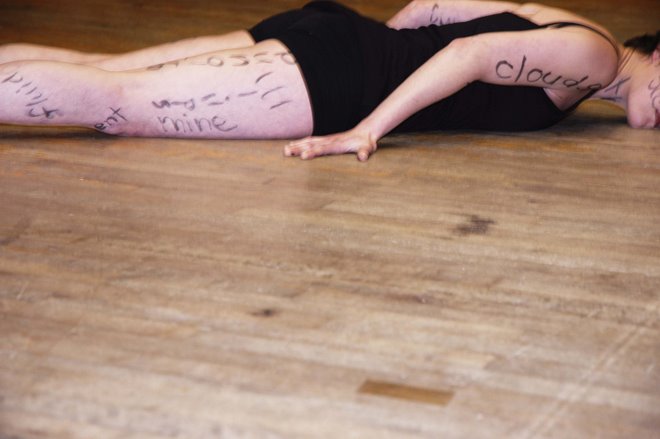
Thanks to James Oliver Gallery, a new outlet of the bodiverse project - in the form of a 35-minute non-video-art-video-art work, Bodiverse for James Oliver Gallery (I), premieres tommorrow (Saturday, June 18, 6-10PM) in the JOG FEMME show.

I've posted details about the show on Neuro Detour.... I'm writing blindly here (need my treatment). So, I'll make this short and throw in an image, and keep you updated on how things go.

I've missed you bodiverse,
Melanie


Sunday, February 17, 2008

Something for the Vault


It's not exactly verse or movement, but I'm certain there's inspiration to be found in this recent quote from Dolly Parton:

"They do seem like public property in a way. They served me well – I don't know if I'm supporting them or they're supporting me."

– Dolly Parton, on her breasts, to Ladies' Home Journal

Monday, December 3, 2007

A Bit About the Live Bodiverse Non-Performance, The Audience Experience, & 1 Short Video

Each Live Bodiverse Non-Performance was created in collaboration with the audience and "performed" and documented in collaboration with Manfred Fischbeck (Music Improvisation), Mathew Davis (Video), and Sayaka Ueda (Photography).

Prior to entering the theater, audience members received the following:

1. A program
2. A release form
3. A description of Bodiverse and their participation in it


Here's part of what the audience read:


FRONT:

Bodiverse: Interactive Process
http://bodiverse.blogspot.com


This is not a performance.
This is a living process.

“The Body is one’s BEING. The Body is the poem.
The Body is the epic of life, and if I can actually transform
the poem into Body and the Body into poem, I will have found my
‘something that’s big enough to fit it all in’."
Ongoing interaction with body, language, space, time, you.
“The body, as a map, provides direction,
and at the same time its complexity
and multi-dimensionality distorts and distracts.”
Please participate.


Participate…

the thought:

1. How and where do you experience yourself in your body?

2. E.g., what is free, contrived, controlled, contradicted within your body?

the action:
3. Write that into one word anywhere on my body.

4. Choose your word and physical location carefully. Please make it legible.

the experience:
5. Your experience as body language will inform this process.

6. It will direct my movement.

7. The language of my movement will represent the conglomeration of experience in this room.

the result:
8. Read the back of this page to learn about what will evolve from tonight’s process.


BACK:

Our Process:

1. You write your experience into my body. This is where tonight's process begins. But in reality, it began when you began. You are bringing your life into this moment. This process will be videotaped (by Mathew Davis) and photographed (by Sayaka Ueda). Please make certain you have filled out a release form if you participate.

2. While the other artists are presenting their work, Melanie Miller will be in the Kumquat Dance Center office crafting your text into a poem or drawing or both and then recording it with a tiny voice-recording device. Both the act of repositioning your text and recording it are "performed" as improvisational actions. This recording will be played during the live process, adding a further layer of influence.

3. Mat will be editing and rendering the video of your entrance, or the writing of your experience onto my body. This video will be projected into the space, also adding another layer of influence.

4. Your words, as they are written on my body, will create/direct my body into motion. This improvisational response should be a sincere interaction between the physical self and the emotional and intellectual self.

5. During the live process, Manfred Fischbeck will respond to all of these improvisational happenings with music improvisation. This is the first time that music has been including in Bodiverse. This is also our first collaboration.

6. The live movement process, which reflects all the processes that led to this moment, will be videotaped with two cameras.

7. Mat and Melanie will co-edit the final work, which will also incorporate Sayaka's photography. The act of editing is improvisational composition and will be created with the same intention as tonight's process.

8. The final process piece(s) will be posted at http://bodiverse.blogspot.com. Please visit the blog and continue the conversation however you like—with text, a video response, a visual response, etc.

9. You will be listed as collaborators. Your names will be collected from the release forms.

10. Thank you for your participation in this process. If you would like to continue your involvement in Bodiverse or Junction Dance Theatre’s other interactive movement projects, please e-mail jdt@junctiondancetheatre.org.

***


Here's a video clip of what the audience experienced when they first entered the theater:


The body writing lasted 10-20 minutes each night. And each night the audience interpreted their interaction differently. It's evident just by the words they chose:

10/27


power
being
rejoice
bicep
hope
bizarre
temptation
core
breathe
flowing
construct
in between
shame
internal
one
tender
woven
constricted
banana

10/28

my heart
joints
move
button
persevere
hands
rendevous
solar
plexus
impulse
empower
bitchin'
spine
hands
be
include
envelope
joints

The word banana from the first night was written by a stuffed monkey.

This performance was the first time other people, most of whom I had never met before, wrote on me. I actually found the experience to be more comfortable with strangers. The moment of writing created a relationship between us, literally between us; not necessarily between two people but amongst air and cells and intention and meaning. And that relationship was colored by our interaction, the way they stood around me, how they held the marker, the pressure with which they applied their words, their level of comfort. Some people began writing immediately while others stood and contemplated where and how. With the people I knew, it altered our relationship at that moment in time.

Sunday, December 2, 2007

Discussing the Live Process at a Tech Rehearsal in a Very Cold Blackbox: 3 Clips

On October 27 and 28, I presented the first interactive Bodiverse process in Speil Uhr, a performance featuring dance and video works by emerging and established choreographers. The posts over the next few weeks will show the process and results--from the tech rehearsal to the non-performance to the final, or rather semi-final, film. Here are three clips of a tech rehearsal discussion with other Bodiverse collaborators and fellow Spiel Uhr performers.


Pictured: Melanie Miller, Manfred Fischbeck (Bodiverse Musician & Group Motion Artistic Director)


Speaking: Manfred Fischbeck, Melanie Miller, Matt Sharp(Lighting Designer), Dancers

Video: Mathew Davis

Monday, April 23, 2007

Letter of Process

The body—our bodies, other bodies, my body—is a reference book for living into the past, present, and future. It is the map of life—our lives, other lives, my life. It is both an example and a symbol of nature and nurture. It straddles the sciences. It negotiates space and time. It communicates and interprets. It is historically accurate. It is an essay on cultural ethics, gender politics, ecology, family, architecture, gerontology, comparative religion, education, sexual revolution, work ethics, and class. It is mystical and explainable. It is form and content. It is predictable and irregular. It is layered. It is taken for granted. It is worshipped and adored. It presents us to the world. I have a mild obsession with the human body.

My parents put me in dance class when I was three. I recall that early experience as: step, touch, step, touch, clap, clap, stomp. Whether or not those memories evolved from the experience, photographs, or my later work as a teacher of movement, it set me on a kinesthetic path.

My child and adult life is recorded in terms of the body. My work has been physical, in that it has been “of the body”: professional dancer, choreographer, dance teacher, waitress, bartender, cleaning woman, hoagie maker, etc. For me, writing is a channeling of experience via the body, and this could be taken to mean body experience or experience as understood by the body or experience channeled from mind through the body to the page, and all would be correct and some would probably be unaccounted for.

While living in Berlin in 1997, I had the clear realization that my life experiences, both good and bad, were stored in my body. The signal: injury. The response: ten sessions of Rolfing. The result: still injured, but I began my secondary inquiry into the body’s mind and the structural integration of bones, ligaments, fascia, memory, and experience.

On February 8, 2007, I defined what I knew about the external world. Stripped to its essence, this piece of writing pointed to how I processed that world via the body:

I know about bones and muscles, connective tissue and fascia. How the body knows more than the mind. It processes relationships better than people ever can.

I know how to dance and how to dance and not think about dancing or death or hate or the dirt under the refrigerator. I also know how to dance and think about alignment and technique and height and weight and lightness and creasing into another body and supporting.

I know the floor is support. I have practiced falling inside and outside on Marley and pavement.


So, in creating this investigative project, it seemed clear that my obsession with the body, my constant return to the internal world of connective tissue and fascia and its external world of gesture and feeling, was saying, continue moving, continue writing, continue seeing and watching, continue thinking and sleeping, continue touching and feeling, but continue in a new way.

I could read as much fact, fiction, or sci-fi that I could or will find about the human body, and I have and will read as much as I have or will have time for or mental ability to process. But in order to understand it, I need to send that information, whatever information my mind retains either voluntarily or involuntarily, into the body itself. And I need to push my ways of processing before and after that channeling.

So, with no ability to draw or understanding of drawing techniques, I began to sketch my body experiences, understandings, readings, research, and responses. And then I began recording myself responding to those sketches. And then I went into the dance studio and wrote those words onto my body, and I recorded myself responding to those body poems. So the result, I hope, is a body poem of a body poem of a body poem of a body poem. In other words, a layering of honest and impulsive (i.e., improvisational) responses of my perception of the body, which is layered and complex like our minds and our lives and our mind-realms and the realms of the worlds we live and take part in.

Immodestly, I hope to eventually discover a new body language. At this moment, this language represents only my experiences. As this project grows, I plan to include other bodies and other realms of experiencing through the body than my own frame of reference carries.

The body, as a map, provides direction, and at the same time its complexity and multi-dimensionality distorts and distracts. I am prone to distraction, and the physical and mental tangents of the body variously pull me out of line and center me. I read Claudia Rankine’s book, Don’t Let Me Be Lonely, at the perfect time. Her non-linear poetic essay demonstrated a cohesive arc of reference and experience that I needed to be reminded of, that I needed to practice in my own editing of the improvisational exercises that make up this project. (An important point: this project is a process not a project. I need to rename it, Bodiverse Process not Bodiverse Project.)

On March 10, 2007, Kristin Prevallet wrote to me, “You have laid out a multi-year project that started long before this class began and will continue long after. In it are the seeds of your own vitality.” This, followed by reading Anne Waldman’s Iovis II, where, documented in a letter from K to Anne on page 36, she writes, “But anyway, it’s this whole idea about an epic that I am finding fascinating, that is, about how one goes about bringing one’s BEING into the poem…” is when I realized this body poem process is my epic project.

In response to the last citation, I wrote: “The Body is one’s BEING. The Body is the poem. The Body is the epic of life, and if I can actually transform the poem into Body and the Body into poem, I will have found my 'something that’s big enough to fit it all in.'”

Any outside eye is helpful. Even if we disagree with it, it frames our work differently. I am particularly grateful to Christina Lundberg’s and Melissa Kozakiewicz’s close reading of my initial writings on this process. Christina asked me, “What is this project fascinated with?” And I believe that disembodied question is so important to the content of the work, because, 1) I haven’t been able to pinpoint that and 2) it is a disembodied question, which is the opposite of the embodiment of the mind/body relationship, but the same in that the concept must at some point be disembodied to write about it in an essay-like manner, rather than intuit it in a physical, improvisational one. Melissa wrote to me, “Dealing with your body problems is more interesting than dealing with someone elses. I encourage you to say the things that may be painful or gross if you have any of those things in your world.” I took this motivation with me into my improvisations, and returned to it, when I felt I was avoiding my own honesty.

The body poems posted on this blog are examples of process and product, improvisation and choreography. Each piece resulted from various genres of improvisation. The video editing was both improvisational and choreographic. How can something be improvisationally composed? I have been choreographing dances for stages, site-specific spaces, and the public realm for more than ten years. In the beginning, my choreographic structuring was conceived. I had to work hard. Today, there are many instances when it feels like muscle memory. I have no video editing experience, yet these little pieces seemed to come together as instinctually as a dance. So, to me, even the pieces that do not include a physical body in motion are dances of language, language in the sense of modes of communication. They are body poems-improvised visual choreographies of, for, and with the body.

Friday, April 20, 2007

References

Everything I read, see, feel, touch, taste, know, regard, disregard, engage in, ignore, interpret, or misunderstand during the creative course is digested and becomes part of my physical-mental being. This includes things and beings that do and do not breathe. The following is a sampling of the sources of my digestion immediately leading to and during this time period.


In Person:

Tara Blaine
Karen Finley
Manfred Fischbeck
K. Scott Forman
Larry Krevolin, DO
Melissa Kozakiewicz
Christina Lundberg
Brian Miller
Maureen Miller
Zoey Bleu Miller
Kaen Oyler
Kristin Prevallet
James Thomas Stevens
Sayaka Ueda


In Print:

Body Criticism: Imaging the Unseen in Enlightenment Art and Medicine
Barbrara Maria Stafford. The MIT Press, 1993.

The Book of Jon
Eleni Sikelianos. City Lights, 2004

Can Humanity Change?
J. Krishnamurti. Shambhala Publications, Inc., 2003.

The Conquest of Happiness
Bertrand Russel. Liveright, 1971.

Civil Disobediance: Poetics and Politics in Action

Anne Waldman and Lisa Birman. Coffee House Press, 2004.

Dictee
Teresa Hak Kyung Cha. University of California Press, 2001.

A Different Kind of Intimacy
Karen Finley. Thunder’s Mouth Press, 2000.

Don't Let Me Be Lonely

Claudia Rankine. Graywolf Press, 2004.

From the Warring Factions
Ammiel Alcalay. Beyond Baroque Books, 2002.

Gray’s Anatomy: Fifteenth Edition
Henry Gray. Barnes & Noble, 1995.
NOTE: Referenced in audio text on the sternum (project not yet completed).

The Handmade Museum
Brenda Coultas. Coffee House Press, 2003.

Imaging Her Erotics: Essays, Interviews, Projects

Carolee Schneeman. The MIT Press, 2003.
Note: A Coherent Muscular Life is based on a quote from this book.

IOVIS Volume 2
Anne Waldman. Coffee House, 1996

Jane (a murder)

Maggie Nelson. Soft Scull Press, 2005

The Language of Inquiry
Lynn Hyjinian. University of California Press, 2000.

New Beauty: The Wrold’s Most Unique Beauty Magainze
Midwest. Issue 1. Volume 3. Winter-Spring 2007.
NOTE: Text for audio recordings of plastic surgeon’s wives borrowed from interviews. Project not yet completed.

Paterson

William Carlos Williams. New Directions, 1995

The Penguin Dictionary of Symbols
Jean Chevalier and Alain Gheerbrant. John Buchana-Brown (Transl.). Penguin Books, 1996.

Pierce-Arrow

Susan Howe. New Directions, 1999.

Private & confidential letters from Linda A. Kerns, Esquire

Linda A. Kerns, Esquire.

Robert Mapplethorpe and the Classical Tradition
Germano Celant and Arkady Ippolitove, with Karole Vail. Guggenheim Museum, 2004.

This Blood Spilled in My Veins

Jalal Toufic Âshûrâ. Forthcoming Books, 2005.

Various Renal Pamphlets.
National Kidney Foundation of Illinois, Inc.

Wisdom of the Body Moving: An Introduction to Body-Mind Centering

Linda Hartley. North Atlantic Books, 1989.
NOTE: Bold font in Writings on Bodies I–IV is borrowed from this book.


In Virtual Space:

www.city-data.com/forum/pittsburgh/17747-few-questions-about-w-pa.html

www.animalnewyork.com/2006/05/saks_goes_slumming.php
www.blissymbolics.us/lessons/arm/
www.city-data.com
www.en.wikipedia.org/wiki/Elbow-joint
www.en.wikipedia.org/wiki/McKeesport,_Pennsylvania
www.en.wikipedia.org/wiki/Type_of_gesture
www.feeds.feedburner.com/TheContemporaryTaoist
www.glamour.com/horoscopes/dreamdictionary/viewsymbol?symbol_id=1113
www.ika.ie/diet.html
www.marshall.edu/akanart/abramo.html
www.mckasd.com
www.mckeesport.org
www.mckeesportgospelhall.org/south_hall2.gif
www.metmuseum.org/explore/newegypt/htm/wk_pecto.htm
www.nzart.org.nz/nzart/Exam/morse.htm
www.pep-web.org/document.php?id=apa.003.0697a
www.sec.state.ma.us/cis/cismaf/mf1a.htm
www.shakespeare-art-museum.com/Rummy/Rummy06.html
www.shutterstock.com/cat.mhtml?searchterm=elbow
www.templechryses.org/mm.html

Thursday, April 19, 2007

Background on "Wings of the Body" Video

The final entry came together in a haphazard way. Here is the chain of events:

3.20.07
I drew this in my journal with a carbon pencil, white charcoal pencil, and a yellow highter:
scan0037


In the bottom left corner I wrote:

Know when to accept
sun to ribs & when
to acknowledge the
dark sides of
the body.
Today my ribs unpeel
as onion skin.
Something has shifted.
Wings are the
body opening
through the white page
& into the net page
& from there
who knows.


3.30.07
Fly to Pittsburgh and visit family. Get flu. Give everyone the flu.


4.3.07 - Present
Flu develops into pesky cold and then into invincible Bronchitis. Coughing fits. Achy body.


4.12.07
Become distracted by my personal life and feel like petrified bones. Temperature continues to drop.


4.13.07 Rehearsal Day
It's cold outside. It's cold in the studio. I add layers. Even leg warmers from who knows what year. Don't want to move. Can't get out of my thoughts. Always leave your baggage at the studio door-I know-but couldn't. Film just hand moving. Film just back moving. Decide to push further. Stand on head for 3 minutes. Momentarily warmer and clearer. Remove sweats and sweater. Keep leg warmers. Try to move. Hopeless. Call it a day.


4.15.07 Editing Day
Downlaod video to hard drive from 4.13.07 failed movement day. Realize my breasts are distracting in the back film. I am concerned by voices in my head that tell me I am inappropriate. Apply various filters to mask them. I am, in effect, censoring my own skin. I know this, but do it anyway. The result is pleasing.


4.19.07 Voice Recording
Embark on recording my voice again even though still nasally. Record text from journal entry above. Think, aha! This relates to the back recording. Edit together in VideoStudio software program. Convert to mpeg. Upload to YouTube. Post on Blog.

Body Language Isn't Universal

scan0008
Medium: Charcoal, Marker, Watercolor, Red Editing Pen

This drawing was inspired by a conversation with one of my fellow Naropa classmates, Kaen Joyler. At the bottom of the sketch I wrote, "isn't it funny how even body language, once codified, isn't even universal. (Monday) 3/26/07"


Here is the original conversation thread:


kaen,

your post made me think of margins as a sense of control on the page. i'll get to my point (eventually). i can't remember if this was one of my thoughts, or something i'm misquoting from one of our readings as of recent, but it's this restriction of space that seems to correlate to the restriction of language, and i'm seeing language at this moment as such a restriction when/if we are limited by its potential by writing in only one. however, what's interesting is that alcalay's text was only in english. what do you think? have i made any sense?!


melanie-

are you thinking of silliman's chinese notebook [ e.g. #63, #64, esp #176 ]?

restriction is okay with me. a form of discipline. it's everywhere. the important thing, i guess, is to acknowledge the restriction, to have it serve the poem, incorporate it.

remember my korean poems from last year, justified on the right-hand margin? none of the korean poets i've met want to have anything to do with me. there could be many reasons for that.

but that's the difference between accepting and acknowledging restriction that correlates to a restriction of language. as our ideas of space change, so can our ideas of how language functions.

and your point about alcalay's text being only in english is well taken. he admits to only being able to read other languages. and this is certainly a point to focus on.

in that respect, i might start from the position that since his subject matter is not the "american" experience, his use of his native language, english, is an act of translation.

it's in his idea of monolingual consciousness, and the choice he makes to use english as his linguistic vehicle. this is acknowledging limitation, or restriction, not merely accepting it as de facto.

perhaps this is speaking more to Olson's idea of grammar that was taken up in the other thread. i mean, within the framework of SAE, how is it possible to referentially use english in a non-american context?

and this brings me to issues of ownership and possession, which i kind of want to set to the side, though i will share something that shows how "out of control" english truly is on the international stage.

this picture is of children's socks being sold on the streets of seoul. kristen, perhaps you'd like a couple pair for your daughter?

-kaen

Host unlimited photos at slide.com for FREE!
Photo courtesy of Kaen Joyler


[from me to kaen]

i'll take 2 for size 7.5 shoe! really, kid's socks? is the meaning lost? dismissed? coopted? misunderstood? isn't funny how even body language, when it becomes codified, isn't universal.

Monday, April 16, 2007

Bodiverse: Refocused

Thanks to feedback, I realized that original brainstorming list required a lifetime of work. So I am allowing myself to take a lifetime to process it. In the meantime, I set new parameters for the beginning, which is now.

Here is that outline:


Body Poem-refocused
Language/Text/Body/Film/Performance/Movement


Works to Research:

Imaging Her Erotics by Carolee Schneemann
Various texts on the body (in personal library but in storage until 2/17)
Various texts on performance art (“)
http://www.caroleeschneemann.com/index.html
“A Different Kind of Intimacy” by Karen Finley
My personal body history


Means:

Each day make a freeform list.
Choose one list to cut and paste to my body each week.
Go into studio for 1 hour and move with this list on my body.
Videotape (need to buy a digital camcorder for JDT project anyway)
Record thoughts before and after with voice recorder.
Create daily(?) body sketches. Sketch the world/self into the body.
Photograph? Do I invite someone into the process? Or select stills from the video – yes.
Montage into final project.


Free body explorations-
Areas of pain, holding, freedom, comfort.
Do I rehearse the same time/day each week, or vary it. I prefer late morning to evening. Why?
Body Poem-refocused
Language/Text/Body/Film/Performance/Movement


Works to Research:

Imaging Her Erotics by Carolee Schneemann
Various texts on the body (in personal library but in storage until 2/17)
Various texts on performance art (“)
http://www.caroleeschneemann.com/index.html
“A Different Kind of Intimacy” by Karen Finley
My personal body history

Means:
Each day make a freeform list.
Choose one list to cut and paste to my body each week.
Go into studio for 1 hour and move with this list on my body.
Videotape (need to buy a digital camcorder for JDT project anyway)
Record thoughts before and after with voice recorder.
Create daily(?) body sketches. Sketch the world/self into the body.
Photograph? Do I invite someone into the process? Or select stills from the video – yes.
Montage into final project.

Free body explorations-
Areas of pain, holding, freedom, comfort.
Do I rehearse the same time/day each week, or vary it. I prefer late morning to evening. Why?

Sunday, April 15, 2007

Preparation for First Movement Session

This sketch documents my rough ideas the night before my first filming session.

Host unlimited photos at slide.com for FREE!
Medium: #2 Pencil


The morning of the drawing: I was intimidated to go back into the studio. I had anxiety. I gave myself a pep speech. In essence, it said, get over yourself.

The night before the drawing: I was slightly less or slightly more or both at various times still intimidated. I drank wine and smoked cigarettes (in moderation). I read through my notes, listened to the voice recordings I had so far, leafed through my journal, and re-read, and re-listened, and re-looked, and re-drank, and re-smoked...

Three years before the drawing: Bilateral hip injury propells me to redirect focus from body maintenance (specifically the intense maintenance required to dance professionally) to mind maintenance. The pain stopped movement, breath.

Three years before the drawing to six months before the drawing: So I took very small steps. After all, I, like so many artists, was uninsured. Marriage cured that, but not the steps. Needles and dye...deep tissue massage...cortizone...into the acetabulum...I still took small steps.

Jump forward to September 2006. I did not jump yet, but time did. Still insured. Still married. Still blocked in the joints. But diagnosed. Now foggy, like I was living behind a scrim, and voices were filtered for maximum audio distortion. i.e., meds.

Jump forward to February 2007. I did not jump yet, but regulated, separated, sounds and thoughts are normalizing, not yet normal, but I still haven't found an adequate definition of normal.

Jump forward to March 2007. I did not, but I assume you can and I can't. I'm procrastinating going into the studio. The HDcamera hasn't arrived. Postone 1 day, another, and another.

Jump forward to April 2007. The camera arrives, and now what? What do I have to say with my body? Can it still speak?

The Origin of Bodiverse

Notes from my first brainstorm on this project:


2/15/07
Body Poem
Language/Text/Body/Film/Performance/Movement


Works that Speak to Me & Research:

1. Imaging Her Erotics by Carolee Schneemann
2. Can Humanity Change? J. Krishnamurti
3. Various texts on the body (in personal library but in storage until 2/17)
4. Various texts on performance art (“)
5. History of Sexuality, Foucault
6. http://www.caroleeschneemann.com/index.html
7. Cecilia Vicuna various performative-based works and Web resources
8. Karen Finley’s performative texts and sketches
9. My personal body history
10. Personal ads
11. Jenna Jameson’s lists and rules.
12. History of costumes: http://www.costumes.org/HISTORY/100Pages/costhistpage.htm
13. Go to bookstore and pick a book on body politics, if not in library already.
14. Physiology, biology, and history of the kidneys.
15. Kidney pamphlets sent to me from The Kidney Foundation (in storage).
16. Interview a plastic surgeon. Maybe schedule a consultation (if I can find a free one) and record it.


Questions to ask myself/ Things to do/consider:

1. How does one feed a body?
2. How do I feed my body?
3. What is sustenance?
4. What is my/other’s sustenance?
5. Possibly interview peers, strangers, plastic surgeons, doctors.
6. Think about porn vs. prude.
7. What is my body’s religion?
8. What secrets are held in my/your body and where?
9. Whose body is this?
10. How does music in poetry relate to music of the body?
11. What is music of the body? Is it noise the body makes or the lyricality of movement?
12. If my body was superhero, which one would it be?
13. What would it do?
14. Separation of mind from body. Distinction.
15. Connection of mind to body. Distraction. Defraction. Blur.
16. Bruises and scars. Whose are they? What do they signify? Pain or healing? Personal or universal?
17. What is a universal body?
18. How can my body change the world?
19. Body art – painted bodies. Aboriginal and contemporary and bloody and other forms of coverings (birth/surgical/casts/burqa/wigs/yarmulka).
20. The soldier’s bloody body.
21. The victim’s bloody body.
22. The refugee’s bloody body.
23. A philanthropic body.
24. The medicated body.
25. The open body.
26. The peaceful body.
27. The perfect body.
28. The imperfect body.
29. What are these types of bodies?
30. I must narrow my scope.
31. How narrow is the scope of the body?
32. Is there a body part that says more than another? Less than another?
33. What parts of the body are mute? If any?
34. Do I avoid religion?
35. Research disguises and the history of costume.
36. Record my nephrologist at my April follow-up.
37. Kidneys in chinese medicine and alternative medicine.
38. Aspects of the mind that the kidneys relate to.
39. Various personal illnesses and injuries as they can relate to a broader self/world/politics.
40. Politics of women’s health.
41. Plastic surgery.
42. What do bodies want/need?
43. The body as site.
44. The body as city/world/place/placement/displacement.
45. Sites for the body: kitchen, sidewalk, desk, pool of water, snow, bed. Where do we place our bodies? How does this affect our identity?
46. If we had no body, what would our identity be? A voice? A thought?
47. Then, what is more powerful?
48. Explore how the form of the body and the form of poetry can mold the form/construction of this project.
49. Body as defiance/submission.


Ways & Means:

1. Create a Web site or a blog for it? For final product? Or from start with questions for response to include in the final project?
2. Buy/rent/ or borrow a digital camera. Maybe a cheap Internet
3. Buy/rent/or borrow video and sound editing software. Use connections at Drexel.
4. Interview & record people on the street. One question only. Ask different questions on different days. What do you think of my body? What does my body tell you? What do you think of my body language? Can you improvise a poem about my body? Have you ever hurt another person’s body? (not sure if I could get anyone to answer this one.)
5. Maybe make up answers to those questions from various voices as well. Write them as a play for various voices?
6. Paste words and lists to my body. Move with that word in that body part. Record it. Write it. Write onto my body. Take photographs. Use this exercise to develop material for final project.
7. Collect personal ads and how they describe their bodies and what they want in other’s bodies. Paste them to my body? Personals cut ups? Body cut ups.
8. Interview a plastic surgeon. Maybe schedule a consultation (if I can find a free one) and record it.


Quick first draft – not really:

I’m not ready to do this. It will need to be a physical process with sketches. I will scan what I do and post it. Not sure how I’ll upload video in progress. Might be able to upload some of the voice recordings. Seek collaborators? I have this tendency to expand projects, and this one seems to be growing out of my skillset, but I’m really interested in exploring it as a solo project too. Maybe I can find a local film/sound engineering student to help with the editing.